
26 Oct 2026
MEMS DC Accelerometers Are Built for Crash Testing
Every crash test result, from restraint performance to structural response, depends on accurately capturing a pulse that lasts only milliseconds and peaks at many times the force of gravity. The accelerometers recording that event need to measure it faithfully and survive it intact, run after run.
Silicon Designs MEMS DC Accelerometers are designed for the
severity of crash testing. Engineers use them on crash sleds, impact rigs, and
vehicle structures for several reasons:
- They capture the whole pulse.
DC response means no low-frequency roll-off. The sensor records the
sustained deceleration plateau and the rebound, as well as the peak.
- They survive the hit.
Modules are rated for mechanical shock up to 5,000 g, depending on range,
so one sensor can serve many test runs.
- They measure orientation, too.
Because they respond to static acceleration, they can track tilt and body
angle during and after an event, such as in rollover testing.
- Their data is traceable.
Every module is factory calibrated and serialized, which supports the
documentation that test programs require.
- They fit the setup.
Ranges run from ±2 g to ±400 g. Low-mass options fit in tight spaces.
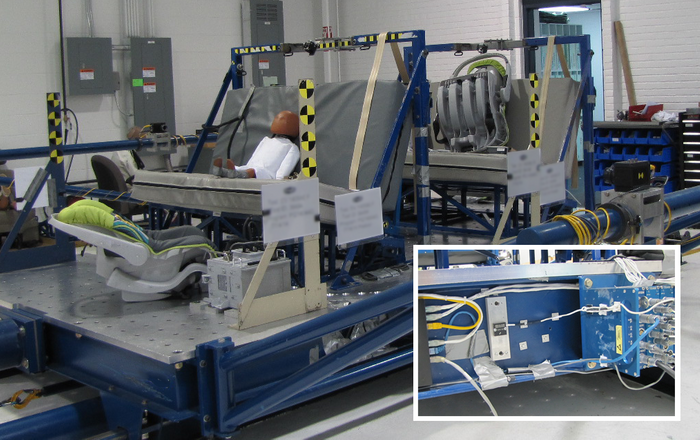
In practice: the sled pictured here is instrumented with an
SDI 2210, SDI’s best-selling single-axis module, mounted on the sled frame
(inset). In that position, it records the pulse used to confirm that each run
matches the required test profile.
Planning a sled or crash test program? Talk with our team about
the right range for your pulse.